The Scarman report’s findings
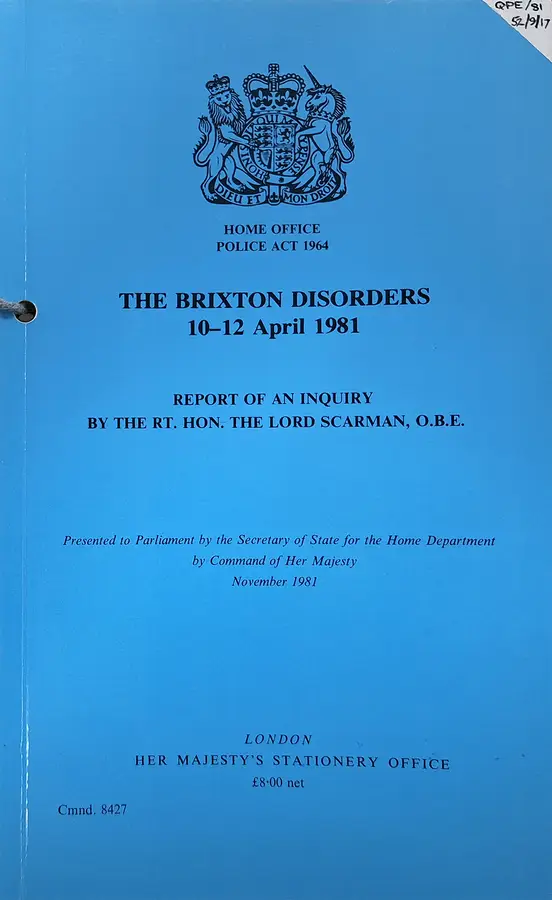
Lord Scarman published his report on 25 November 1981, notably emphasising that the disturbances in Brixton were primarily rooted in social and economic deprivation.
The evidence which I have received […] leaves no doubt in my mind that racial disadvantage is a fact of current British life. It was, I am equally sure, a significant factor in the causation of the Brixton disorders. […] “Institutional racism” does not exist in Britain : but racial disadvantage and its nasty associate racial discrimination, have not yet been eliminated.
[…]
The attack on racial disadvantage must be more direct than it has been. It must be co-ordinated by central government, who with local authorities must ensure that the funds made available are directed to specific areas of racial disadvantage. I have in mind particularly education and employment.
Extracts from the conclusion of Lord Scarman’s report
The report received criticism for its apparent minimisation of allegations regarding police misconduct and for its conclusion that institutional racism was not a feature of British society.
Eighteen years on, the Macpherson Report, which followed the botched investigation into the racist murder of Stephen Lawrence, would highlight the same issues. It came to a different conclusion: that institutional racism exists ‘in the Metropolitan Police Service and in other Police Services and other institutions countrywide’.
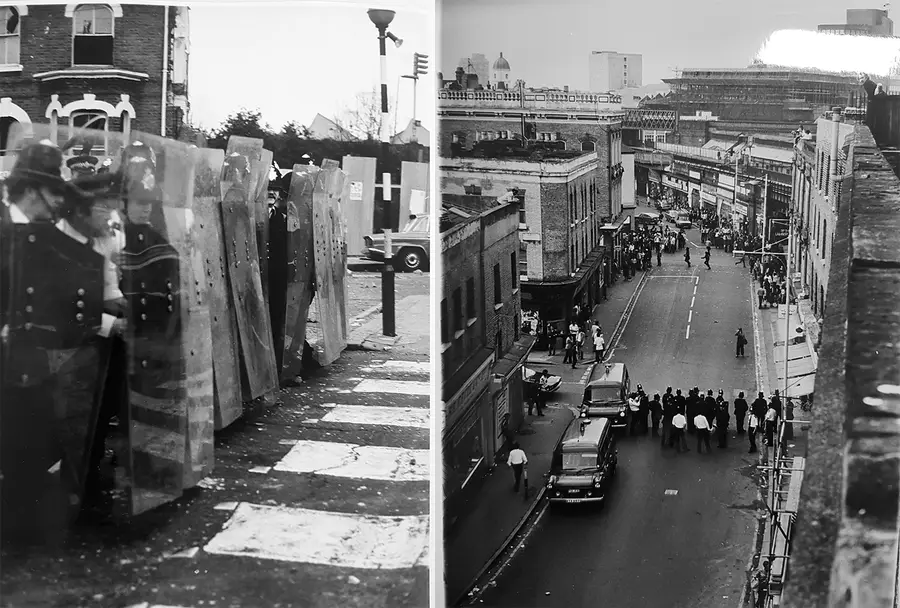
The Brixton riots (or uprisings) weren’t the first incidents of disorder or protest in London or on Britain’s streets, and neither were they the last. In 2011, for example, the England riots (also known as the London riots) began in North London and spread across the city and the country – including to Brixton, 35 years on.
As I said earlier, I was as a young Black British man, I also found these incidents deeply concerning; however, I was cognisant of the historical tensions between law enforcement agencies and Black communities, notably the Rastafarian community. These tensions are acknowledged to have longstanding roots.

I was seventeen years old and had embarked on my A-Levels. I had an active inerest in national politics and was, like the school’s debating society, engrossed in the recently formed The Social Democratic Party (SDP) a centrist to centre-left political party in the United Kingdom. The SDP was founded on 26 March 1981 by four senior Labour Party moderates, dubbed the “Gang of Four”: Roy Jenkins, David Owen, Bill Rodgers, and Shirley Williams. , who issued the Limehouse Declaration.
The calamitous outcome of the Labour Party Wembley conference demands a new start in British politics. A handful of trade union leaders can now dictate the choice of a future Prime Minister.
I had joined my school’s debating society, with national politics consistently being a primary focus. When the tragic events of the 1981 Brixton Riots captured national attention, I took on a role as a spokesperson advocating for the rights of Black communities. My in-depth knowledge of Rastafarian culture proved to be particularly valuable in these discussions.
Lord Scarman’s comprehensive report on the Brixton Riots of April 1981 was officially released in November 1981. I greatly commend Lord Scarman’s integrity and professionalism in his assessment. The Scarman Report significantly contributed to the prioritisation of law enforcement and policing issues within public discourse. The theme of the Scarman Report was broadly welcomed, accepted and endorsed by politicians, police commissioners, the press and community relations officials.
The evidence which I have received […] leaves no doubt in my mind that racial disadvantage is a fact of current British life. It was, I am equally sure, a significant factor in the causation of the Brixton disorders. […] “Institutional racism” does not exist in Britain : but racial disadvantage and its nasty associate racial discrimination, have not yet been eliminated.
[…]
The attack on racial disadvantage must be more direct than it has been. It must be co-ordinated by central government, who with local authorities must ensure that the funds made available are directed to specific areas of racial disadvantage. I have in mind particularly education and employment.
Extracts from the conclusion of Lord Scarman’s report
To mark the publication of the report, a debate was convened in the House of Commons, themed around ‘law and order’, during which the then Leader of the Liberal Party, Mr David Steel, emphasised the need for prompt and decisive measures to prevent escalation into unlawful activities.
However, in 1999, the Macpherson Report noted that several of the recommendations outlined in the Scarman Report had not been adequately addressed and concluded that, in essence, the Metropolitan Police had characteristics of institutional racism.
A subsequent debate in March 1982 revisited the events of 1981, addressing concerns regarding urban decline, increased street violence, crime rates, and the potential for further unrest should changes in policing strategies and social policies not be implemented promptly. While both Conservative and Labour representatives in the parliamentary discussion expressed the importance of supporting law enforcement, significant divergence remained on the extent to which social deprivation and unemployment contributed to the participation of young individuals in violent protests.
The 1981 Scarman Report explicitly advised that concerted efforts should be made to recruit more people from ethnic minority groups into the police force. Lord Scarman, investigating the 1981 Brixton riots, identified a “loss of confidence” in the police by local communities and recommended that the police service should become more representative of the communities it serves.
In 1982, after extensive discussions with my parents, siblings, friends, teachers, and the local priest, I made the significant decision to pursue a career with the Metropolitan Police Service. I was grateful for the support and encouragement I received from all parties, who agreed that I had the potential to make a meaningful contribution towards fostering positive relationships between the police and our communities. I submitted an application to join the Metropolitan Police Service, which was fortunately enough successful.
A local police sergeant paid a visit to my parents and myself, during which he conducted an interview regarding my reasons for aspiring to join the Metropolitan Police Service. I explained to him that I was motivated by the findings of the Scarman Report, authored by Lord Scarman, which highlighted a loss of confidence in the police among local communities. The report also emphasised the importance of the police service becoming more representative of the communities it serves. I conveyed to the sergeant that I believe I possed the essential qualities to contribute positively towards building constructive relationships between the police and the community.
My family and I were delighted to receive the invitation to attend the formal interview at the Metropolitan Police Training School in Hendon. We were further pleased when I subsequently received another correspondence inviting me to join the Metropolitan Police.
I completed my training at the Metropolitan Police Training School in Hendon. Upon successful graduation, I was assigned to serve at the renowned Bow Street Police Station, located in the vibrant neighbourhood of Covent Garden and the Theatreland district of the West End. Working in this dynamic area provided diverse and engaging experiences, as it involved addressing a wide range of incidents and interacting with a diverse spectrum of the public on a daily basis.
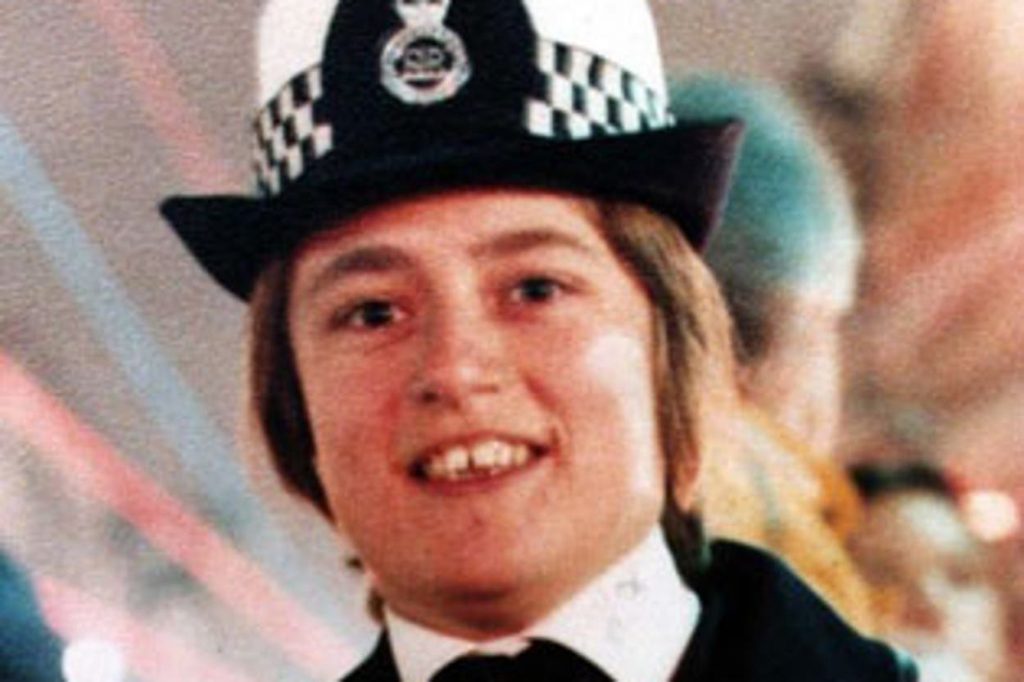
On 17 April 1984, I was shocked to hear of the murder of WPC Yvonne Fletcher a Metropolitan Police officer who was fatally wounded by a shot fired from the Libyan embassy on St James’s Square. I was a colleague of WPC Yvonne Fletcher. We were on the same “D” relief team at Bow Street. Yvonne Fletcher, had puppy walked me around Bow Street Division which helped me familiarise me the area I was policing. WPC Yvonne Fletcher was very popular and will be sorrly missed.
Located directly opposite Bow Street Police Station is the renowned Royal Opera House. Enhanced security measures are consistently maintained during royal visits for special galas and premieres, which often necessitate road closures and the deployment of barriers to ensure safety and facilitate smooth operations.
I had the opportunity to meet the duty manager of the Royal Opera House on several occasions during my time at Bow Street Police Station, where I was graciously invited to observe rehearsals of ballet and opera productions during my time off duty. These memorable experiences fostered a lasting appreciation for ballet and opera that remains with me to this day.
Unfortunately, despite after a wonderful successful probation where I had become a popular member of the relief, having made great relationships with my work colleagues. Despite Lord Scarman’s advocacy of the importance of the police service becoming more representative of the communities it serves, relationships between the Metropolitan Police and the various black communities in London blew up again in 1985.
The Brixton unrest of 1985 commenced on 28 September. It was precipitated by the police shooting of Dorothy “Cherry” Groce during an operation conducted by the Metropolitan Police, who were attempting to apprehend her 21-year-old son, Michael Groce, in connection with a robbery and suspected firearms offence; officers believed that Michael Groce was present within his mother’s residence.
The Broadwater Farm riot occurred on the Broadwater council estate in Tottenham, North London, on 6 October 1985. The events of the day were dominated by two deaths. The first was that of 48-year-old Cynthia Jarrett (June 1937—05 October 1985), a Jamaican woman, born in Clarendon, Jamaica, who had died the previous day due to heart failure during a police search at her home.
It was one of the main triggers of the riot, in a context where tensions between local black youth and the Metropolitan Police were already high, due to a combination of local issues and the aftermath of the 1985 Brixton riot which had occurred the previous week, following the shooting of a black woman, Cherry Groce, during another police search.
The second death was the murder of Keith Blakelock, the third police officer since 1833 to be killed in a riot in Britain (all three being in the Metropolitan Police)
These events in 1985, especially the murder of police officer Keith Blakelock, led to fresh tensions between the police, the black community, polititacions, other coommunitiy leaders, and church leaders. I became a spokesperson for the police liasing team whose role was to continue positve conversations.
I continued to serve at Bow Street Police Station until 1987. In 1987 I was alleged to have commited a series of of serious criminal offences which had to be investigated by senior officers from Scotland Yard. I was fully exonerated. However, some of my colleagues took a disgracefull advantage of the invesigations and began harrasing me and making racist remarks.
As a result of this abuse I requested a move to another police station as I was preparing for my sergeant’s exam. I enjoyed the police and was determined to make a successful police career. I was granted a move because at the time my senior officers belived in me. Six months later I formally resigned because the abuse arose agian due to an officer at my new station who had a partner at Bow Street Police Station. This officer disgracefullu spread malicious false rumours about me which impacted on my professinal relationships with my colleagues, to the chagrin of my new senior officers who had accepted my total innocence. In light of this appalling behaviour of my day to day colleagues, I resigned.
I have over the years, I have requested an official apology from the Metropolitan Police for my treatment when I was in their service. Despite my unblemished service in the Metropolitan Police, vicious individuals within the Metropolitan Police caused incidents which impacted on my professinal relationships with my colleagues.