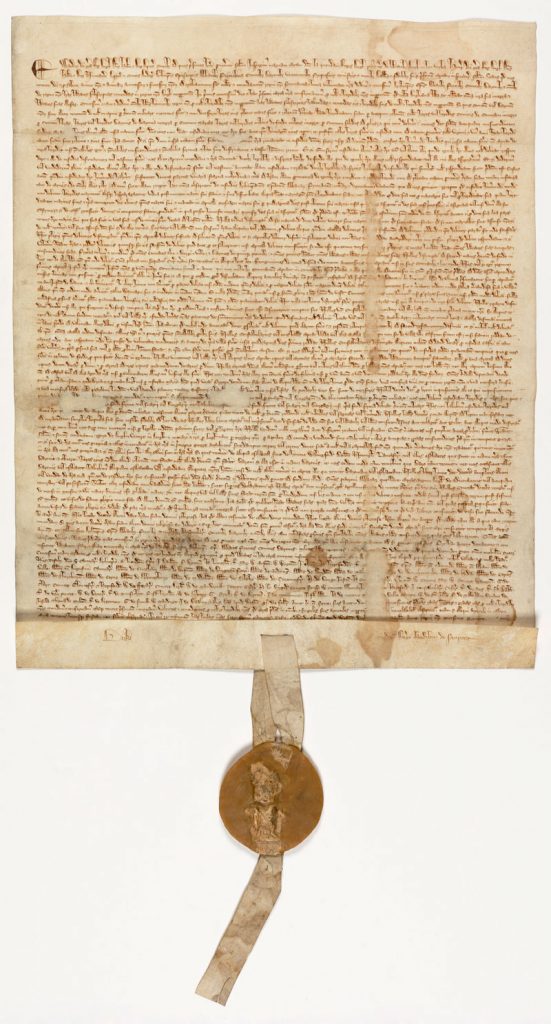
The Magna Carta was formally engrossed, sealed, and issued by King John at Runnymede, located between Staines and Windsor, on 15 June 1215. This followed a period of five days of detailed discussion and negotiation, during which many of the Articles of the Barons—initially accepted in principle by King John—were expanded upon, reorganized, or subdivided, and gaps in coverage were addressed. Of the Articles, only Article 13 lacks a direct equivalent in the Magna Carta; conversely, six chapters of the Magna Carta (Articles 1, 14, 19, 21, 24, 57) do not mirror any of the Barons’ Articles, as detailed in the accompanying clause-by-clause commentary.

The drafting of the Great Charter in Latin, a language historically associated with religious ceremonies, academic dialogue, and both secular and ecclesiastical administration, highlights its considerable importance. This significance is additionally demonstrated by the document’s extensive scope, encompassing a minimum of sixty chapters.
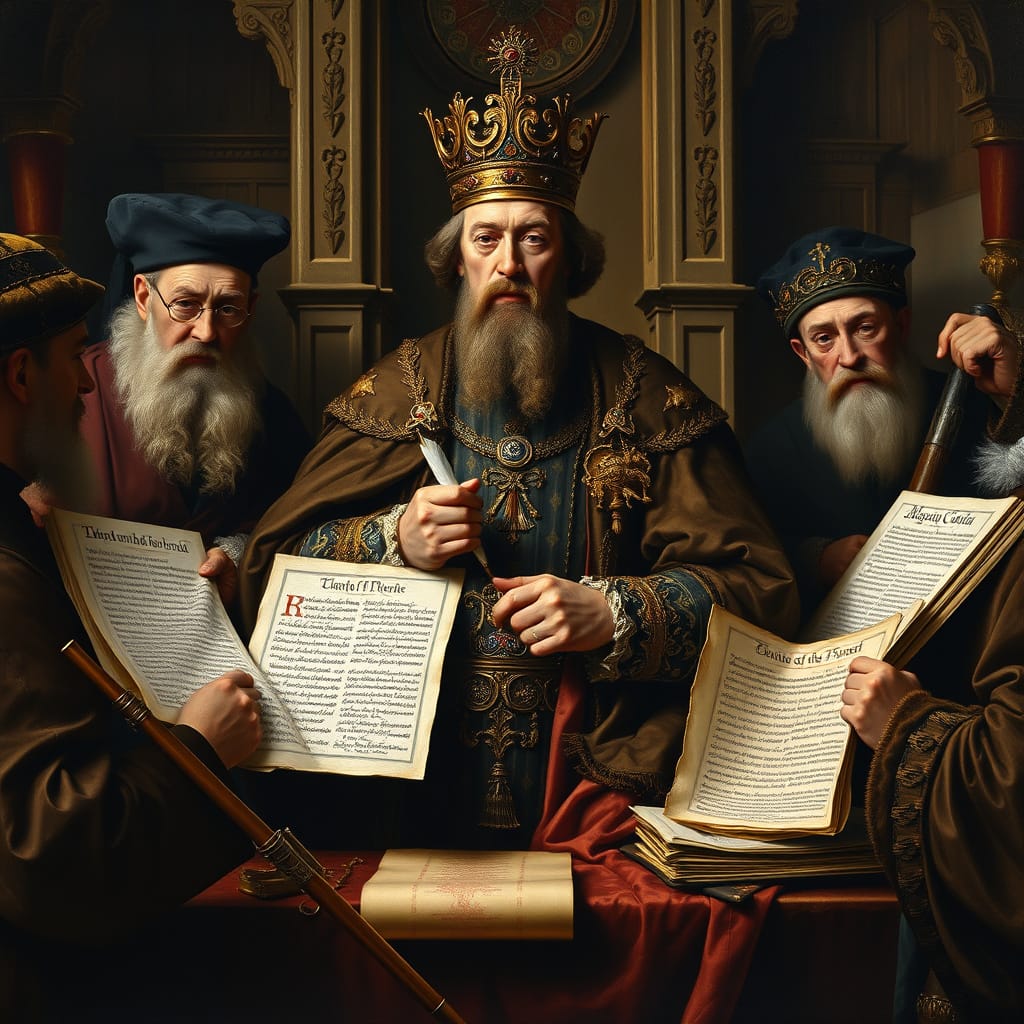
Originally referred to as the “Charter of Runnymede,” the document acquired the name Magna Carta in 1217, following its reissue under the authority of King John’s successor. The edition of the 1215 Charter provided here is derived from the version edited by Bishop William Stubbs in the late 19th century, which is widely recognised as a reputable and authoritative text. Please be advised that ongoing scholarly research may lead to future updates and revisions to the document and its translation.

Four original manuscripts of this edition are known to exist: two housed at the British Library, one at Lincoln Cathedral, and one at Salisbury Cathedral.
Recommended Further Reading:
- D. A. Carpenter, Magna Carta (London, 2015)
- D. A. Carpenter, “The Dating and Making of Magna Carta,” in The Reign of Henry III (London, 1996), pages 1–16
- J. C. Holt, Magna Carta (2nd edition, Cambridge, 1992)
- J. S. Loengard (editor), Magna Carta and the England of King John (Woodbridge, 2010)
- N. C. Vincent, Magna Carta: The Foundation of Freedom 1215–2015 (London, 2015)
- N. C. Vincent, Magna Carta: A Very Short Introduction (Oxford, 2012)
Magna Carta Sealed Audio Commentary
Referenced in
Introduction: Articles of the Barons 1215 (The Articles of the Barons)

John by God’s grace king of England, lord of Ireland, duke of Normandy and Aquitaine, count of Anjou, to his archbishops, bishops, abbots, earls, barons, justices, foresters, sheriffs, reeves, officers and all bailiffs and subjects, greeting. Know that for the sake of God and for the salvation of our soul and the souls of all our forebears and heirs, to the honour of God and the advancement of holy church, and the reform of our kingdom, by the counsel of our venerable fathers Stephen, archbishop of Canterbury, primate of all England and cardinal of the holy Roman church;

Henry, archbishop of Dublin; Bishops William of London, Peter of Winchester, Joscelin of Bath and Glastonbury, Hugh of Lincoln, Walter of Worcester, William of Coventry and Benedict of Rochester; Master Pandulf, subdeacon and confidant of the lord pope, Brother Eymeric, master of the Knights Templar in England; and the noble men William Marshal, earl of Pembroke, William, earl of Salisbury, William, earl of Warenne, William, earl of Arundel, Alan of Galloway, constable of Scotland, Warin fitzGerold, Peter fitzHerbert, Hubert de Burgh, seneschal of Poitou, Hugh de Neville, Matthew fitzHerbert, Thomas Basset, Alan Basset, Philip d’Aubigny, Robert of Ropsley, John Marshal, John fitzHugh, and others of our subjects:
‘The 1215 Magna Carta: Preface’, The Magna Carta Project, trans. H. Summerson et al.
http://magnacarta.cmp.uea.ac.uk/read/magna_carta_1215/Preface accessed 02 January 2026
Magna Carta Audio Commentary
Referenced in
King John grants freedom of election (The Itinerary of King John)
Magna Carta 1215 Clauses
Magna Carta Clause 1
1
We have first of all granted to God, and by this our present charter confirmed, for ourselves and our heirs in perpetuity, that the English Church is to be free, and to have its full rights and its liberties intact, and we wish this to be observed accordingly, as may appear from our having of our true and unconstrained volition, before discord arose between us and our barons, granted, and by our charter confirmed, the freedom of elections which is deemed to be the English Church’s very greatest want, and obtained its confirmation by the lord pope Innocent III; which we will ourselves observe and wish to be observed by our heirs in good faith in perpetuity. And we have also granted to all the free men of our kingdom, for ourselves and our heirs in perpetuity, all the following liberties, for them and their heirs to have and to hold of us and our heirs.
Magna Carta Free Elections Commentary
Referenced in
Clause 60 (The 1215 Magna Carta)
Drama and jokes at Bury St Edmunds (The Itinerary of King John)
Magna Carta’s Legacy & Influence
- Rule of Law: It enshrined the idea that even the monarch is subject to the law, a core concept for later challenges to arbitrary power.
- Due Process: Clauses like “no free man shall be seized or imprisoned… except by the lawful judgment of his equals or by the law of the land” (Clause 39) became foundational for rights to fair trial and freedom from arbitrary detention, notes this EachOther article.
- Universal Interpretation: While initially for nobles, its principles were expanded over centuries to apply to everyone, becoming a symbol for broader human rights, notes the British Institute of Human Rights and this LSE article.
Connection to the Black Civil Rights Movement (UK & US)
- Inspiration, Not Direct Cause: The Magna Carta didn’t cause the Black Civil Rights Movement but provided a historical framework and language for demanding universal rights.
- Challenging Discrimination: Activists used the principles of justice and equality (like those in Clause 40: “To no one will we sell, to no one deny or delay right or justice”) to fight systemic racism and unequal treatment.
- Expanding Citizenship: The movement redefined citizenship, claiming full inclusion based on the very idea that rights should apply to all, not just powerful groups, notes this University of Manchester blog post.
- Landmark Use: Figures like Nelson Mandela invoked Magna Carta, and the US Supreme Court referenced it when questioning practices at Guantanamo Bay, showing its enduring power in rights discourse, say Britannica and this YouTube video.
In essence, the Black Civil Rights Movement, like other rights movements, drew on the Magna Carta’s legacy to argue that principles of liberty and justice were inherent human rights, not privileges for the powerful, notes this Black History Month UK article and this University of Manchester blog pos
The Magna Carta of 1215 established foundational legal principles such as the rule of law and due process, which significantly influenced subsequent civil rights movements by asserting that no individual, including the monarchy, is above the law. Originally, these provisions primarily applied to the barons; however, over time, the language—particularly clauses emphasizing justice and fair trials—was reinterpreted to support universal human rights. This reinterpretation served as a key cultural and legal foundation for later advocacy efforts, including those of the Black Civil Rights Movement, which built upon these core ideas of liberty and equality to promote equal rights and challenge discriminatory legislation.
Legacy and Influence of Magna Carta
- Rule of Law: It established the principle that even sovereign authority is bound by law, serving as a cornerstone for challenges to unchecked power.
- Due Process: Provisions such as “no free man shall be seized or imprisoned… except by the lawful judgment of his equals or by the law of the land” (Clause 39) laid the groundwork for rights related to fair trials and protection against arbitrary detention, as highlighted by authoritative legal analyses.
- Universal Principles: Although originally intended for the nobility, the principles enshrined in Magna Carta were progressively extended to all citizens over the centuries, transforming into a symbol of broader human rights, supported by scholarly sources including the British Institute of Human Rights and academic articles.
Connection to the Black Civil Rights Movements (UK & US)
- Historical Inspiration: While Magna Carta did not directly cause the Black Civil Rights Movements, it provided a vital historical narrative and language for advocating universal rights and justice.
- Addressing Discrimination: Activists drew upon principles such as justice and equality—illustrated by clauses emphasizing fair treatment—to combat systemic racism and unequal treatment.
- Redefining Citizenship: The movement sought to expand the concept of citizenship to ensure full inclusion and equal rights for all individuals, grounded in the fundamental belief that rights are inherent rather than privileges reserved for select groups, as discussed in analyses from the University of Manchester.
- Enduring Symbolism: Prominent figures such as Nelson Mandela invoked Magna Carta, and later legal institutions, including the U.S. Supreme Court, referenced its principles when evaluating issues like detention policies at Guantanamo Bay, demonstrating its continued relevance in rights discourse, according to Britannica and related scholarly commentary.
In summary, the Black Civil Rights Movement and other advocacy efforts have historically drawn upon the legacy of Magna Carta to argue that principles of liberty and justice are inherent human rights. This perspective challenges the notion that rights are privileges of the powerful, as noted in articles from Black History Month UK and University of Manchester resources.
Contemporary Significance
Legal scholar Francesca Klug emphasizes that the principles rooted in Magna Carta remain vital today, underpinning ongoing human rights discussions. The 800th anniversary of Magna Carta further underscores its importance as the foundation of modern protections for individual liberties and equal rights.
References
- EachOther.org.uk: “Magna Carta: The Origin of Modern Human Rights”
- University of Manchester: Analyses of civil rights evolution and their historical roots
(For further reading and detailed discussions, please consult the respective sources.)
The Magna Carta, sealed by King John in 1215, is a seminal document that established the principle that the monarch is subject to the rule of law, thereby limiting arbitrary royal authority in matters such as taxation, justice, and feudal rights.
The Magna Carta provided an essential foundation for individual liberties, the development of the rule of law, and parliamentary governance. Although originally a political agreement between the Crown and influential barons rather than a universal declaration of rights, its core principles of legal checks on authority have significantly contributed to the evolution of broader freedoms over subsequent centuries and have influenced key constitutional developments, including the United States Constitution.
Key Principles and Significance of the Magna Carta
Context and Evolution Rule of Law:
Marks the first occasion on which comprehensive written restrictions were imposed upon royal authority, affirming that the monarch is subject to the law.
Limited Government: Imposes constraints on the monarch’s powers concerning areas such as unjust taxation and arbitrary detention.
Foundation for Liberty: Enshrines provisions safeguarding rights for ‘free men’, including due process and access to justice, thereby laying the groundwork for subsequent notions of individual rights.
Symbol of Freedom: Although initially applicable to barons, its principles have been adopted by various movements—such as the suffragettes—and have evolved to become emblematic of liberty and democracy on a global scale.
A Political Compromise: Emerged from a crisis involving a rebellion by barons against King John’s despotic rule and excessive demands.
Not Contemporary Democracy: Its focus was directed towards specific medieval grievances and the privileges of the elite, rather than universal human rights as understood today.
Enduring Legacy: Its enduring significance lies in establishing the primacy of the rule of law over sovereign power, serving as a foundational element for modern constitutional governance.
History of Civil Rights in the UK
Written by Editorial Team 28/05/2021
Civil liberties in the United Kingdom are part of UK constitutional law and have a long and formative history.
It is usually considered to have begun with the Magna Carta of 1215, a landmark document in British constitutional history.
Early History of British Immigrants
The slave trade in Britain was first documented around 1562 and by the early 18th century there were 14,000 black people living in Britain.
The development of civil liberties advanced in common law and statute law in the 17th and 18th centuries, notably with the Bill of Rights 1689. Then during the 19th century, working-class people struggled to win the right to vote and join trade unions. Eventually, Parliament responded with new legislation beginning with the Reform Act 1832.
Few still had any real freedom, and it was not until the abolitionists began protesting that slavery across all of the British Empire was banned in 1833. By 1892 Britain had its first Indian Member of Parliament, Dadabhai Naoroji.
After World War II 150,000 Poles arrived in Britain along with hundreds of men from the West Indies and multi-cultural Britain had arrived.
Attitudes towards suffrage and liberties progressed further in the aftermath of the first and second world wars. Since then, the United Kingdom’s relationship to civil liberties has been mediated through its membership of the European Convention on Human Rights.
The Mass Migration
During the 1950s Britain invited workers from the Caribbean especially Jamaica to fill job vacancies such as labourers and transport workers in order to help rebuild post-war Britain.
As the rise in immigration continued so too did the rise in racial violence in cities such as London, Birmingham, and Nottingham.
Racial discrimination in Britain during the postwar period was rife. Many of the immigrants were skilled workers but racism and discrimination meant that semi or unskilled work was the only option.
By the 1960s the economy in Britain was declining and unfortunately, black workers were the first to lose their jobs. Those that did manage to keep jobs usually did double the work for less pay.
The racism and discrimination in Britain echoed that felt in America at the time, although on a smaller scale.
The Bristol Bus Company Saga
There were a number of black people who made a difference to the civil rights of the black population in Britain. One was Paul Stephenson, who in 1963 led a boycott against a racist public bus company.
The Bristol bus company operated a colour bar that refused employment to blacks or Asians. Stephenson, a 26-year-old teacher, organised the 60-day bus boycott on the city’s buses. Thousands of people supported the bus boycott and the news of racism made headlines. By 28 August 1963, the bus company lifted the employment colour ban.
Ironically, this was the same day that Martin Luther King Jr made his “I have a dream speech”.
Anti-Discrimination Laws
Paul Stephenson hit the headlines again when he stood trial for refusing to leave a pub until he was served a beer. It was not uncommon to see signs in Britain during the 1960s proclaiming, “No blacks, no Irish, no dogs”.
Both cases helped to highlight the treatment of black and Asians in Britain during this period. By 1970 the amount of non-white residents in the UK numbered 1.4 million, although a third of this number were born in Britain.
The government by then had begun to curb immigration and by 1972 non-whites could only settle in Britain with a work permit or if they had parents or grandparents who were born in Britain.
During Prime Minister Harold Wilson’s term (1964-1976) he introduced tighter controls on immigration but also introduced legislation that made racial discrimination a legal offence.
The UK Law in the 90’s
The United Kingdom, through Sir David Maxwell-Fyfe, led the drafting of the Convention, which expresses a traditional civil libertarian theory. It became directly applicable in UK law with the enactment of the Human Rights Act 1998.
Unfortunately, Civil liberties have been gradually declining in the United Kingdom since the late 20th century. Their removal has been generally justified by appeals to public safety and National Security and hastened on by crises such as the September 11 attacks, the 7/7 bombings and the 2020 COVID-19 pandemic.
Coronavirus Act 2020
In fact the pandemic oversaw the introduction of the Coronavirus Act 2020, which was described by former Justice of the Supreme Court Lord Sumption as “the greatest invasion of personal liberty in [the UK’s] history.”
The relationship between human rights and civil liberties is often seen as two sides of the same coin. A right is something you may demand of someone, while a liberty is freedom from interference by another in your presumed rights.
However, human rights are much broader. In the numerous documents around the world, they involve more substantive moral assertions on what is necessary, for instance, for “life, liberty and the pursuit of happiness“, “to develop one’s personality to the fullest potential” or “protect inviolable dignity“.
“Civil liberties” are certainly that, but they are distinctly civil, and relate to participation in public life.
As Professor Conor Gearty writes, Civil liberties is another name for the political freedoms that we must have available to us all if it to be true to say of us that we live in a society that adheres to the principle of representative, or democratic, government.
In other words, civil liberties are the “rights” or “freedoms” that underpin democracy. This usually means the right to vote, the right to life, the prohibition on torture, security of the person, the right to personal liberty and due process of law, freedom of expression and freedom of association.
Now and Beyond
Over the past couple of decades, our Civil liberties have been tested to the limit by modern technology. We are now all being watched by the government and big corporations, especially over the internet.
Those who do not believe in the big brother are living their lives as a slave to their human rights. There was a line that was not to go over but that has gone over a decade ago.
Now using the pandemic as the reason, governments from the UK to New Zealand are proposing mandatory vaccine passports.
There must be movement soon to say no more…. no more hidden surveillance…. no more collecting our data, no more hidden agendas. This needs to stop.